
Projects
Biotechnological Hub of the NIB (BTH-NIB)
The purpose of the investment project BTH-NIB is the assurance of the appropriate infrastructural conditions for the use of research and developmental opportunities in the fields of operation of the NIB.
Play Video About project Publication
Friends or foes: How potato stress signalling network discerns between the organisms it encounters in different environments
Project coordinator: prof. dr. Kristina Gruden
Code: J4-60073
Duration: 1.1.2025-31.12.2027
Project funding: Slovenian Research and Innovation Agency (ARIS)
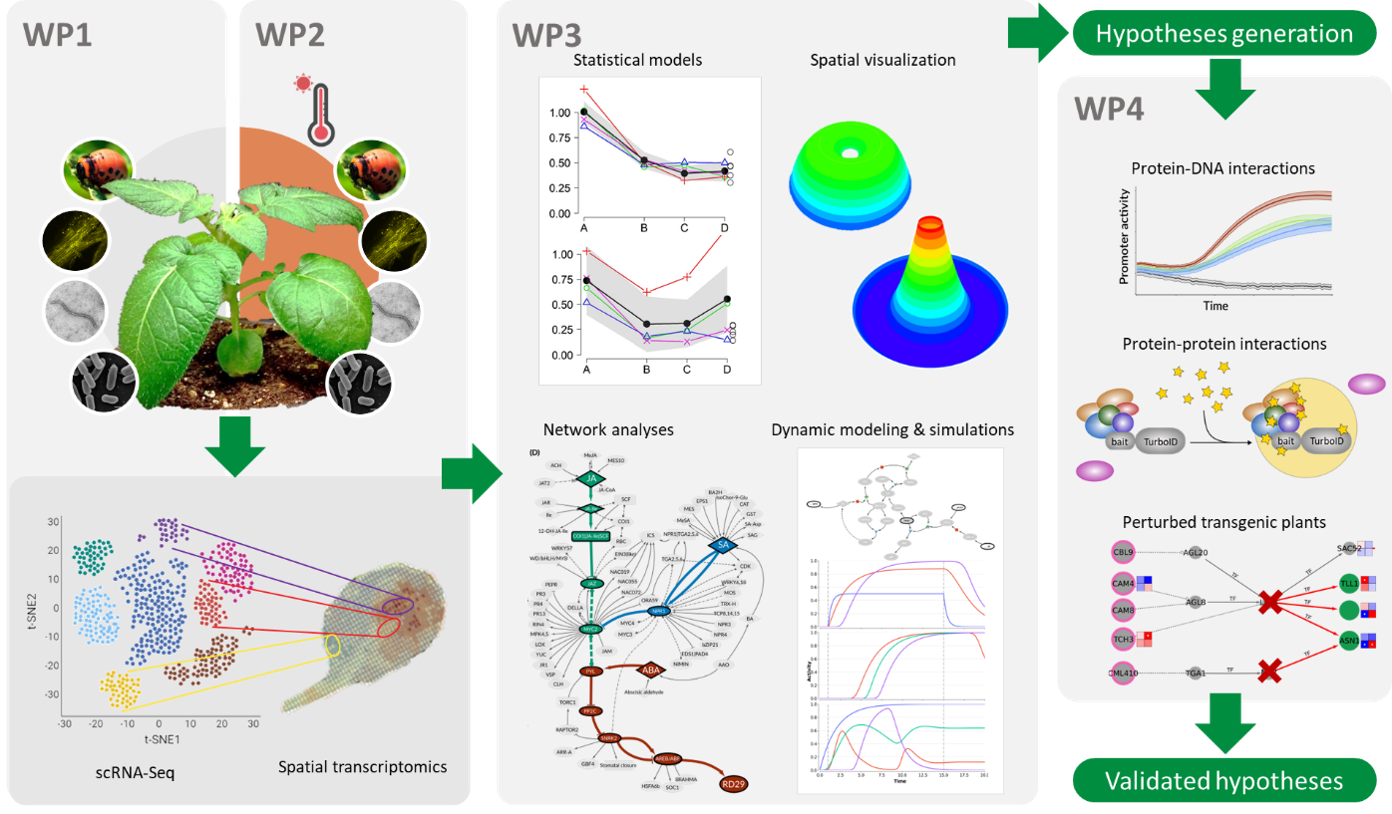
Understanding the complex interactions between plants and other organisms in the environment is crucial to guarantee the development of more efficient and sustainable crop production. Pathogens and pests can, despite the use of chemical pesticides, still cause up to 80% reduction of yields. On the other hand, plant-associated microbiota, including some endophytes, can have a beneficial impact on plant fitness by directly promoting plant growth or through priming of the immune response. These organisms can be used as alternative to chemical pesticides, however they do not show beneficial agricultural properties in all situations in field, indicating that environmental factors are influencing the outcome of interaction. The aim of this project is to decipher the mechanisms determining the outcome of interaction between potato and diverse set of organisms: economically most important virus, PVY, devastating pathogenic bacteria Ralstonia solanacearum, endophytic bacteria Paenibacilus sp. and most important pest, Colorado potato beetle. Specifically, we will also encompass the influence of heat stress on the outcome of interaction and see which mechanisms are disturbed to lead to change of phenotype and thus get closer to agronomical application of plant-growth-promoting bacteria. To address this aim we will take advantage of techniques that have become available recently and offer unprecedented accuracy for following the responses, to the level of individual cells, namely single cell RNA-Seq and spatial transcriptomics. The generated data will be used as a basis for querying the mechanistic model in qualitative and/or quantitative manners. Using such unbiased systems approach we will generate hypotheses on characteristics of signalling network that underline the specificity of response. The hypotheses will be validated in situ or in planta using an appropriate set of methods to study protein-protein or protein-DNA interactions. In summary, the proposed project will provide a breakthrough in understanding the potato in interaction with other organisms and will guide the research towards new strategies for sustainable agriculture. In addition, the precise transcriptomics combined with modelling approaches will advance the research of complex interactions of plants with their environment.
SICRIS
SICRIS
Fast links
Departments and research
Services and products

National Institute of Biology
Večna pot 121, 1000 Ljubljana
Tel: +386 (0)59 232 701
Mail: tajnistvo@nib.si
More about NIB >>


 Scope of NIB's accreditation is given in the Annex to the accreditation certificate and in the List of accredited methods for detection of GMOs and microorganisms – plant pathogens
 Holder of National Standard in the Field of Amount of Substance/Bioanalysis of Nucleic Acids/GMOs and Microorganisms
© 2026- National institute of biology, all rights reserved